
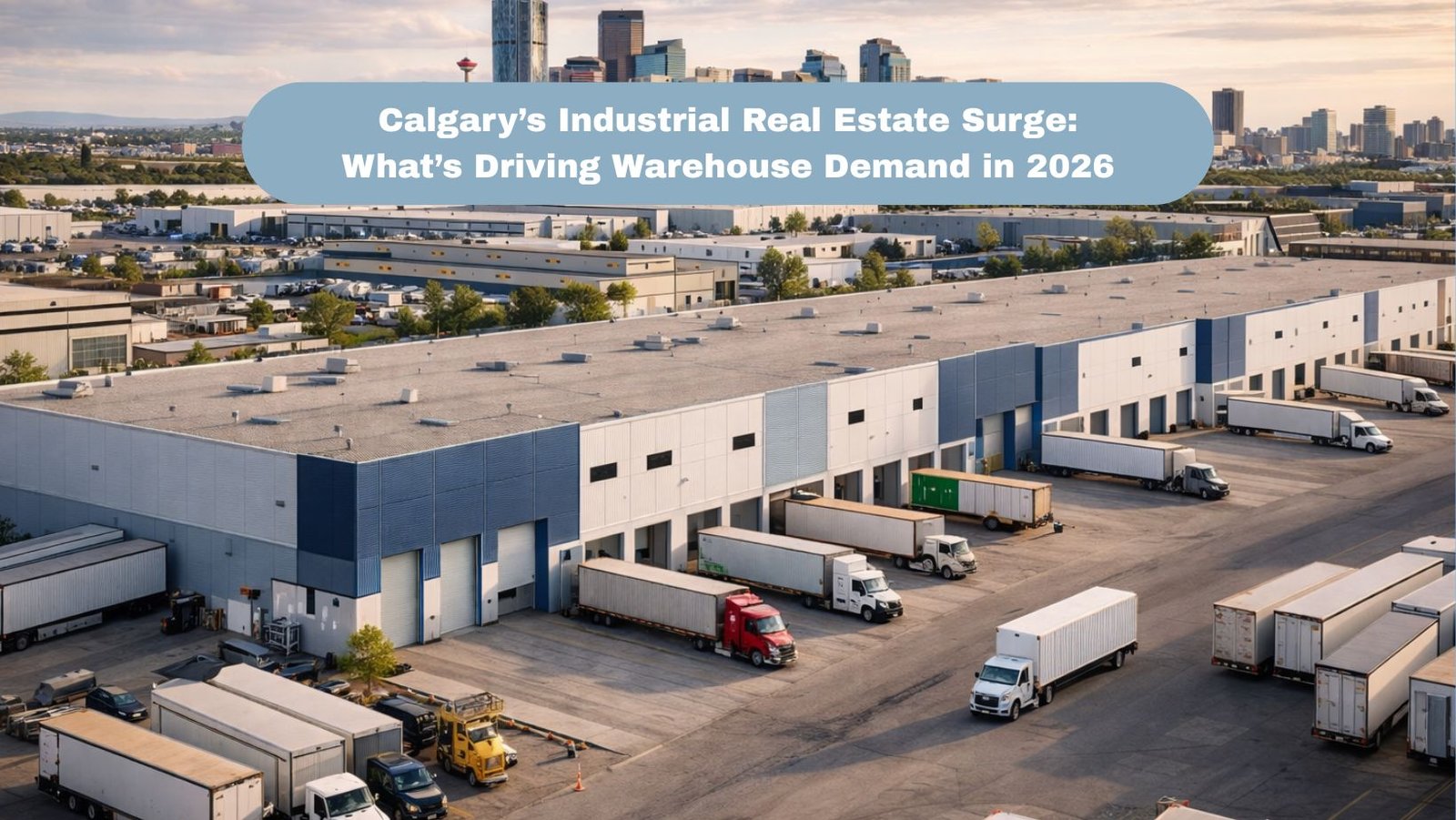
Calgary’s Industrial Real Estate Surge: What’s Driving Warehouse Demand in 2026
Mar 19, 2026
- 0
Introduction
Calgary’s industrial real estate market is seeing a substantial increase in 2026, including in warehouse and logistics space. Industrial Market Steady. Farmers were keen to return to the field for spring planting after a mild winter, and producers were looking forward to shipping their crops in anticipation of new trade flows. This boom is neither a short-term blip nor the result of some hot new thing coming around — it reflects structural changes in how things are moved, where businesses want to be, and what tenants need from industrial properties. Knowing the underpinnings behind these projections provides an essential perspective for developers, investors, and companies considering leasing or constructing space in 2026.
Strong Fundamentals: Demand, Vacancy Trends, and Limited Supply
One of the clearest examples of this can be seen in how vacancy and absorption are playing out in Calgary’s industrial real estate. Following a mid-cycle slowdown, the industrial market has picked back up, with elevated net absorption and falling vacancy through year-end 2025 and into 2026. Recent market analysis indicates tightening overall vacancy and positive absorption, signaling a firm re-engagement of demand in a sector that had been normalizing from historical low vacancy conditions.
One primary reason for that snapback: constrained new supply. Total industrial space under construction is still below long-term averages, and even slight upticks in tenant demand could fill what’s available. These compressed pipelines create more competitive conditions and upward pressure on rents for quality facilities.
However, despite being in “a bit of a rut,” because Calgary’s industrial market has traditionally operated at low vacancy rates — often leading other cities across the country — this current direction is influenced not only by cyclical factors but also by structural opportunities. Businesses are in the market for secure space, particularly for distribution and logistics, and the limited new construction of industrial warehouses adds to competitive pressure.
E-Commerce, Logistics, and Regional Growth
A leading driver of demand for warehouse space across North America has been the rise of e-commerce and logistics, and Calgary is no different. While national and global retail dynamics are ever-shifting, the fundamental requirement for somewhere to store, sort, and shuffle goods remains strong. Its strong industrial market is supported by its ideal location for distribution, as its proximity to major highways, rail networks, and an international airport makes it the prime distribution point in Western Canada.
With the increasing prevalence of omnichannel retailing, short lead-time distribution is a competitive point of difference. Businesses are increasingly looking to locate warehouse space in or around cities to serve last-mile delivery efficiently. Despite struggles with warehouse development, such as automated-fulfillment partnerships, demand for industrial logistics space continues to grow in Calgary submarkets.
This development is also evident in the increasing size of mid-size and small-bay industrial requirements — spaces generally up to 50,000 square feet. These facilities serve uses well beyond the typical large-bay distributor, such as light manufacturing, contractors, and regional supply chains whose needs center on accessibility and ease of operation.
Economic Drivers and Sector Diversification
A range of economic vitality also provides fuel for demand for industrial real estate in Calgary. Energy has long played a central role in Alberta’s financial identity, but broader commercial activity — industries such as logistics, manufacturing, and agriculture — is increasingly driving demand for space. Industrial space use has been enjoying tailwinds, specifically lower interest rates and favorable economic conditions, which have driven tenant expansion and incremental leasing.
Calgary’s industrial sector performs better than other, more susceptible commercial sectors when the economy is uncertain. Office markets, for instance, are still adapting to hybrid work and increased vacancies, even as industrial leasing has remained relatively stable. This relative strength is attracting investment and preserving property values in industrial niches linked to real economic activity rather than speculative demand.
Demand is also underpinned by owner-users — companies looking to buy rather than lease warehouse space. Owner-users frequently seek industrial facilities as their permanent place of business, looking to own the facility and secure a steady revenue stream rather than renewing short-term leases. Nowhere is this more evident than in smaller to mid-sized developments where owner-occupiers make up a large percentage of the block.
Strategic Location and Infrastructure Advantage
Geographically speaking, Calgary doesn’t get enough love. With the intersection of major transportation routes, the city offers excellent access to Alberta’s energy centre and beyond to British Columbia and Saskatchewan. National and international marketplaces are accessible via major highways, including the Trans-Canada and QEII, and via air and rail logistics.
When it comes to industrial users, we often see a focus on locations that maximise transit times and minimise distribution costs. Calgary’s infrastructure eliminates supply chain barriers and creates an alternative to more saturated industrial markets. This competitive position incentivises companies to establish or expand warehouse operations in and around the city, leading to, for example, substantial leasing velocity and investment appetite.
Investment Appeal and Long-Term Outlook
In an investment context, Calgary industrial real estate offers a mix of resiliency, strong fundamentals, and diversification. Although the overall Canadian market shows regional differences, Calgary is again on everybody’s radar due to a supply‑demand equilibrium in the industrial sector that remains relatively tight. Both institutional and private investors consider industrial properties crucial to their portfolios amid ongoing shifts in the economy.
Looking ahead through 2026, Calgary’s industrial profile is poised to continue its upward trend. With vacancy rates expected to tighten and tenant demand competing with limited construction for new space, rental rates could see some upward pressure. Those who look at high location warehouse properties — especially in a few key industrial submarkets — will see continued interest and perhaps even rent growth.
Conclusion
A surge of downtown Calgary industrial real estate in 2026 is propelled by a perfect storm of locational strategic advantages, resilient demand for logistics and e-commerce needs, tight new supply, and diversified economic momentum.” Both locally and nationally, while specific segments of the commercial real estate industry are grappling with transitional market dynamics, industrial real estate, including warehouse and distribution space, remains robust and continues to attract competitors.
For tenants, investors, and developers in Calgary’s warehouse market circa 2026, that means wading into a sector driven by sound fundamentals, long-term demand drivers, and limited surpluses relative to demand. As the market changes, taking the pulse of these foundational forces and their implications will be critical for making choices that capitalize on both short-term breaks and long-term trends.