
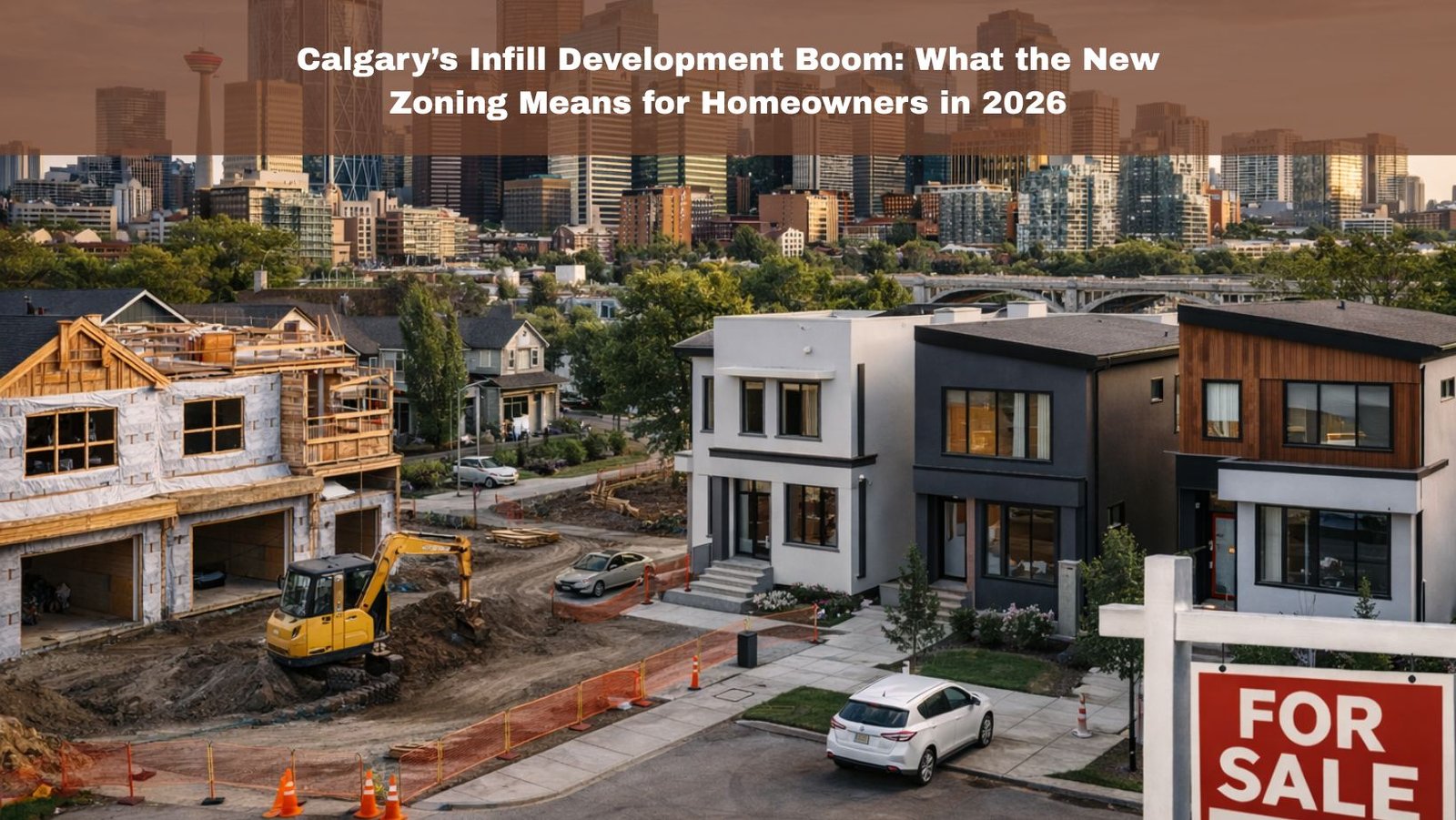
Calgary’s Infill Development Boom: What the New Zoning Means for Homeowners in 2026
Mar 12, 2026
- 0
Introduction
Now, in 2026, infill development has evolved from a planning idea of what could be to an unstoppable transformation in Calgary’s inner-city communities. The maturity of the community population and shortage of urban land have also been contributing factors when coupled with zoning changes to promote redevelopment. For homeowners, that means opportunity and uncertainty. The spread of duplexes, row houses, and small multi-unit buildings is remaking streetscapes long characterized by single-family homes, raising vital questions about property values, lifestyles, and long-term planning.
In Calgary, infill isn’t just confined to a few areas anymore. It is now a city-wide endeavor to increase the supply of housing, make it more affordable, and better utilize existing cash underpinnings. What the new zoning framework allows, and how it affects homeowners, is worth knowing as you navigate Calgary’s changing residential landscape in 2026.
What Changed: Understanding Calgary’s New Zoning Direction
Calgary’s revised zoning approach reflects an overall shift toward low-density development, with a focus on reducing high-rise concentration. Instead of focusing solely on towers in the downtown core, the city has been encouraging a more flexible residential zoning for neighborhoods that are already developed. That will include more widespread permissions for duplexes, secondary suites, townhomes, and small multi-unit developments on lots that previously backed only one detached home.
The purpose of these changes is strategic. Calgary can continue to grow, but growth that spreads out is expensive and infrastructure-heavy. Promoting infill allows the city to squeeze in more residents while minimizing pressure on roads, schools, utilities, and transit. From a planning perspective, this makes sense – it assists in long-term sustainability and fiscal discipline.
But zoning flexibility is creating new realities for homeowners. The property next door can be redeveloped in a way that dramatically impactsimpacts density, parking behaviour, and neighbourhood character. This is dislocating in the short term, but it creates new value streams that didn’t exist before.
Why Infill Development Is Accelerating in 2026
Several factors are converging to fuel Calgary’s infill boom. First, there has been the intensification of land scarcity in central neighbourhoods. With less and less developable land in city centers, developers are eyeing older homes on larger lots for redevelopment. These sites provide the scale to support infill construction under current zoning rules.
Second, prices to build detached homes are still high. Infill projects that yield multiple units on a single lot enhance project economics by spreading land and construction costs across multiple saleable homes. This is why infill is becoming a popular choice for developers working in land-constrained, margin-tight markets.
Third, buyer preferences are evolving. Proximity to work, amenities, and transit is more important to a large number of families than lot size. Infill housing fills this gap, providing contemporary accommodation in existing neighbourhoods—an alignment of zoning, economics, and buyer behaviour that spurred redevelopment and further momentum in 2026.
What Infill Zoning Means for Existing Homeowners
In infill-intensive home markets, zoning changes bring new opportunities — and trade-offs — for homeowners. On the opportunity side, properties eligible for redevelopment may sell at a premium. Land value becomes a larger share of the cost, especially with older homes nearing obsolescence. For owners who intend to sell, it can be more advantageous when builders are more interested than regular end users.
Homeowners who remain could benefit from the potential indirect value of increased investment in the neighborhood. It can also lead to better streetscapes, updated infrastructure , and renewed market interest. This reinvestment, in the long run, can improve the overall attractiveness of a neighborhood.
However, infill also introduces challenges. Construction may disrupt, parking strain can spike, and the long-standing character of a neighborhood can change. Privacy and noise issues are frequent problems, especially as higher-density buildings replace single-family homes. Residents of redevelopment areas are now preparing for such impacts in large numbers by 2026.
How Property Values Are Being Affected
The relationship between infill zoning and property values is complex. When zoning allows for more units and/or higher density, properties with redevelopment potential will typically outperform in price. Often, these homes are priced based on land potential rather than livability.
On the other hand, adjacent properties with aggressive infill can go either way. Some buyers want the new development and density, while others do not like uniformity. The quality of design, size compatibility, and neighborhood context have a significant impact on value.
Also, just because something is infill doesn’t mean it’s going to appreciate on its own. It also depends on the referring market conditions, developer demand, and the specifics of the zoning. Homeowners in 2026 will need to know the zoning of their lot and what is really a redevelopment of it, instead of counting on an accretionary value free for the taking.
Living Beside Infill: Lifestyle and Community Considerations
Beyond pricing, infill development changes the experience of living in inner-city neighborhoods. Higher density can help local businesses, make transit more viable, and lead to more lively streets. This is precisely the kind of long-range urban planning goal that residents – many of them – find attractive.
At the same time, change could look abrupt. Long-time residents can see new infill as demolishing the neighbors they were once drawn to when they moved in. In 2026, it remains a defining element in Calgary’s infill story.
Involvement in the community has always been significant, but increasingly so. More informed homeowners are better equipped to engage meaningfully with change in their neighborhood, knowing zoning laws, development procedures, and appeal processes. No matter what change they bring, at least with awareness, the public is not opposing change per se, but is asking for design quality and responsible development.
What Homeowners Should Do in 2026
Zoning Classification and Redevelopment Potential: Homeowners should first understand their zoning classification and redevelopment potential. A meeting with a planner, real estate professional, or land-use expert may help untangle possible options and expectations. This understanding enables better long-term decision-making, whether the end game is to sell, redevelop, or coexist with infill.
Anyone thinking of selling should closely consider the timing. Demand from homebuilders varies depending on financing and construction costs. Timing is crucial to driving strategic success. Homeowners planning to remain, by contrast, should evaluate how infill will affect their lifestyle and make modest improvements to stay competitive as neighborhood standards rise.
Homeowners who think ahead to 2026 do better than those who wait and react. Infill is no longer theoretical; it’s now a reality that is changing the face of Calgary’s housing supply.
Conclusion
Calgary’s 2026 infill development boom reflects the city adapting to growth, affordability pressures, and land constraints. New zoning rules have unlocked opportunities for higher-density housing in established neighborhoods, accelerating redevelopment across the city. For homeowners, this shift brings increased land value potential, neighborhood reinvestment, and long-term urban vitality — alongside short-term disruption and lifestyle change.
Ultimately, infill zoning is neither inherently positive nor negative. Its impact depends on location, execution, and homeowner strategy. In 2026, those who understand Calgary’s zoning direction and engage with change thoughtfully will be best positioned to protect value, capitalize on opportunity, and navigate the city’s next phase of residential evolution with confidence.