
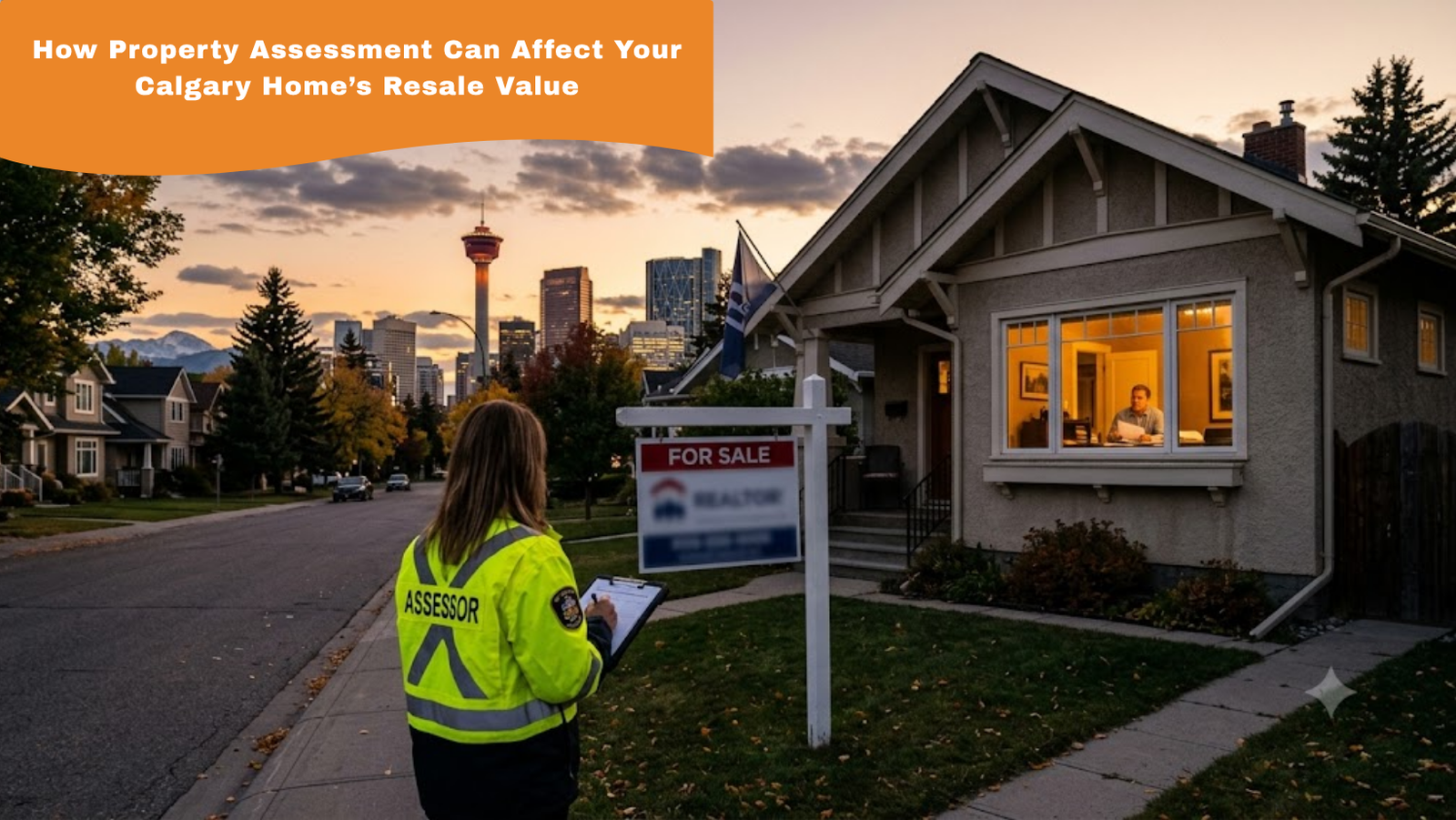
How Property Assessment Can Affect Your Calgary Home’s Resale Value

Here’s a question I hear a lot: “The city says my house is worth this much, so that’s what it’ll sell for, right?”

I understand why people think so. It’s an official number from an official source. But your assessment and your resale value are cousins, not twins. They’re related, they sometimes look alike, and they can also be very different. Let’s sort out how.

Assessment and sale price are two different things.

Your property assessment is the city’s estimate of your home’s market value on a certain date. It exists for one main reason: sharing the property tax load fairly across all properties. The 2026 assessments, for example, reflect values as of July 1, 2025.

Your sale price is something else entirely. It’s what a real buyer agrees to pay on a real day, after walking through your home, comparing it with others, and negotiating. Emotion, competition, timing, and condition all come into play, and none of that fits neatly into a mass assessment. If you want to see how the number feeds into your yearly bill, have a look at our guide to Calgary property taxes.

So does it change what your home sells for?

Not directly. Buyers don’t pay what the city says, and lenders typically rely on their own appraisals. But the assessment can nudge a sale in a few quieter ways.

It shapes first impressions. Buyers and their agents can look up assessed values. If your list price is far above or below it, expect questions. A good agent will explain the gap using recent sales so it doesn’t become a negotiating headache.

It affects the cost of owning the home. Property tax is part of every buyer’s monthly budget. If two similar homes have noticeably different tax burdens, the cheaper one can feel more affordable. It won’t decide a sale on its own, but it sits quietly in the background.

Errors can confuse. If your record shows the wrong size, a basement that isn’t developed, or a garage that isn’t listed, buyers may compare your home with the wrong set of properties. Fixing factual mistakes keeps the story straight, and we explain how to check if your 2026 Calgary assessment is accurate.

The timing gap can mislead sellers. Because an assessment reflects an earlier date, it can trail a rising market or sit above a cooling one. Treat it as a reference point, never as your asking price.

What actually moves your resale value?

If you want the honest list, it’s location, condition, layout, current market conditions, smart pricing, and how well your home is presented. Property type matters too. A condo behaves very differently from a detached home right now, and our posts on condo vs. detached homes in Calgary and Calgary condo market trends explain why.

Renovations, permits, and paperwork

The city looks at your property’s physical condition as of December 31 of the year before the notice, so renovations may show up in a later assessment. But buyers care about paperwork as much as granite countertops. Unpermitted work can complicate your real property report and buyer confidence. Keep your permits, receipts, and warranties in one folder, and use our seller document checklist so nothing is missing when you list.

Before you list: what I’d do

Read your latest assessment notice and check the property details. If something’s wrong, contact the city’s assessment team. Then ask your agent for a comparative market analysis built on recent sold homes, not just the assessed value. Know your yearly tax amount, because buyers will ask. And set your price from real market evidence.

It also helps to know what the sale will cost you, so read Calgary real estate fees explained. And when you meet agents, bring our list of questions sellers should ask before listing.

If you’re a buyer or an investor

Buyers, treat the assessment as one data point, not the price tag. Look at recent sales, estimate the yearly tax, and add it to your monthly budget. Investors, taxes hit your cash flow directly, so run the numbers early. Our posts on top Calgary neighborhoods for investment and the Calgary rental market can help you compare areas.

Myths worth dropping

“My assessment is my home’s value” is a common one, but it’s an estimate for a past date. “A low assessment means a bargain” isn’t reliable either, since it may just reflect timing. And “challenging my assessment will raise my resale value” doesn’t hold, because a successful challenge affects your tax share, not what buyers pay. Finally, please don’t price your home at the assessed value. Price it using today’s market evidence.

Quick Questions

Can my assessment be higher than my sale price?

Yes. It’s an estimate for an earlier date, so your sale price can land above or below it depending on the market.

Do buyers look at assessed value?

Many do, but mostly as a rough reference. They lean much more on recent sales and their agent’s advice.

Should I appeal my assessment before selling?

Only if you believe there’s a real error. An appeal is about your tax share, not your sale price, and deadlines apply. Check your notice.

Curious how your assessment compares with what your home could really sell for? Get in touch with Jai Chaudhary Real Estate for a no-pressure market review, or keep reading on our blog.


Calgary Real Estate Fees Explained: Who Pays What?

Money questions are the ones people are most nervous to ask. How much does an agent cost? Who pays the lawyer? What’s a “closing cost” anyway? Let’s answer them plainly, without any jargon.

One quick note before we start: the figures below are typical ranges meant to help you plan. Actual amounts depend on your home, your brokerage, and your lawyer, so always confirm details in writing.

The Big Picture

In a typical Calgary sale, the seller pays the real estate commission, and the buyer pays for their own legal work, inspection, and land title fees. Both sides have some closing costs. The good news is that Alberta has no land transfer tax, which keeps buying costs lower than in several other provinces.

What Sellers Usually Pay

Real estate commission

This is the highest cost for most sellers. Commission is not set by law, and it’s negotiable. In Calgary, it’s commonly structured as a percentage of the sale price, sometimes with a higher rate on the first part of the price and a lower rate on the rest, and it’s normally shared between the listing brokerage and the buyer’s brokerage. GST is added on top of commission. Ask your agent for the exact numbers in writing. Our post on how long an agent can hold your listing shows where this fits in the contract.

Legal fees

Your lawyer handles the transfer of title, pays out your mortgage, and prepares the statement of adjustments. Fees vary, so get a quote up front.

Mortgage payout and penalties

If you break your mortgage before the term ends, your lender may charge a penalty. It can be a significant amount, so ask early.

Real Property Report and Compliance

A current RPR with municipal compliance is usually needed. See our full seller document checklist for details.

Preparation costs

Staging, cleaning, minor repairs, professional photos, and condo document fees can add up. Some agents include certain services, so ask what is covered.

Property tax and utility adjustments

On closing day, taxes and other prepaid or owing items are split between buyer and seller. For a primer, read our Calgary property tax guide.

What Buyers Usually Pay

  • Down payment. The biggest upfront amount.
  • Legal fees and disbursements. For the transfer and mortgage paperwork.
  • Land title transfer and mortgage registration fees. Alberta charges a base fee plus an amount for every $5,000 of value. At the time of writing, that is roughly $50 plus $5 per $5,000 for the title transfer and $75 plus $5 per $5,000 for the mortgage registration. Check current rates with your lawyer.
  • Home inspection. A smart investment in any resale home.
  • Appraisal or lender fees, if your lender requires them.
  • Title insurance. Often arranged by the lawyer.
  • Property tax adjustments at closing.
  • Condo document fees, if buying a condo.
  • GST, if you’re buying a brand-new home.

Wondering whether you need an agent at all on the buying side? Re: Do you really need a realtor to buy a house in Calgary?

A Simple Example: Selling a $600,000 Home

These figures are for illustration only. Your real numbers will differ.

Cost item Example amount Notes
Total commission at 4% $24,000 Negotiable; not set by law
GST on commission (5%) $1,200 Added on top of commission
Legal fees About $1,000 to $2,000 Get a quote from your lawyer.
RPR and compliance About $500 to $1,000 Depends on the surveyor and timing
Photos, staging, cleaning Varies widely Some agents include part of this.
Mortgage penalty Depends on your lender Ask before you list.


A Simple Example: Buying a $600,000 Home

Using the fee formulas above, the land title transfer on a $600,000 purchase comes to roughly $650, and registering a $480,000 mortgage comes to roughly $555. Add legal fees, an inspection (often a few hundred dollars), and any appraisal or title insurance costs, and many buyers budget a few thousand dollars for closing costs on top of the down payment. Your lawyer can give an exact figure.

Smart Ways to Keep Costs Under Control

  • Ask every agent to write out their commission structure and any extra fees.
  • Get quotes from more than one lawyer.
  • Ask your lender about penalties before choosing a possession date.
  • Fix small things yourself, but skip big renovations that rarely pay back.
  • Prepare your paperwork early to avoid rush fees.
  • Use a written checklist so nothing surprises you.

Not sure which questions to ask about costs? Our list of questions sellers should ask before listing includes the money ones. And if you’re weighing the do-it-yourself route, selling privately in Calgary explains the savings and the trade-offs.

Frequently Asked Questions

Who pays the real estate agent in Calgary?

Typically, the seller pays the commission, which is then shared between the listing and buyer’s brokerages. Always confirm the arrangement in writing.

Is real estate commission fixed in Alberta?

No. It’s negotiable between you and your brokerage.

Does Alberta have a land transfer tax?

No. Alberta charges land title registration fees instead, which are usually much lower.

Are there fees if I cancel a listing?

It depends on your contract. Some agreements include cancellation or marketing cost terms, so read the fine print.

Final Thoughts

Want a personalized cost estimate for your sale or purchase? Reach out to Jai Chaudhary Real Estate, and we’ll map out the numbers together, with no surprises. There’s more to read on our blog.

What Questions Should Sellers Ask Before Listing in Calgary?

The listing consultation is a bit like a first date. Everybody is polite, everybody is a little bit on show, and it’s easy to walk away charmed without learning anything useful.

The fix is simple: go in with questions. Sellers who prepare tend to feel calmer, choose better, and avoid nasty surprises later. Here’s a list you can take with you, grouped by topic, with a quick note on why each one matters.

Before the Meeting: A Bit of Homework

  • Gather your key papers, like your title, RP, R, and tax bill. Our document checklist shows what to pull together.
  • Write down your goals: price, timeline, and any hard deadlines.
  • Decide what you’re willing to fix or update.
  • Plan to meet two or three agents so you can compare.

Questions About the Agent

  • How long have you been selling in Calgary, and how many homes did you sell last year? It shows how active they are.
  • How many of those were in my neighborhood or a similar home type? Local knowledge beats general experience.
  • Who will I be working with day to day? Some agents pass clients to assistants. It’s good to know upfront.
  • Can I speak to a couple of recent clients? Confident agents say yes.

Want to sharpen your instincts even more? Read how to spot inexperienced real estate agents in Calgary.

Questions About Pricing

  • How did you arrive at this list price? Ask to see comparable sales.
  • What would happen if we priced it higher or lower? Good agents can explain the trade-offs.
  • How is the market behaving for homes like mine right now? If you own a condo, ask about supply and recent price shifts too. Our post on Calgary condo market trends gives useful background.
  • When should we adjust the price if there’s little interest? Have the strategy before you need it.

Questions About Marketing

  • What’s your marketing plan, step by step?
  • Do you use professional photography, video, and floor plans? And who pays for them?
  • Will you hold open houses, and how do you handle private showings?
  • How will you promote my home beyond MLS?
  • Can I see examples of your recent listings?

Questions About Fees and Costs

  • What is your commission, and how is it split?
  • Are there any extra fees, like admin or marketing charges?
  • What other costs should I expect, like legal fees or mortgage penalties?

Our guide to Calgary real estate fees, who pays what, will help you make sense of the answers.

Questions About the Contract

  • How long is the listing agreement? Our post on how long an agent can hold your listing explains typical terms.
  • What happens if I want to cancel?
  • Is there a holdover clause, and how long does it last?
  • Does the agreement renew automatically?

Questions About Process and Communication

  • How often will you update me, and how? Phone, text, or email?
  • What’s a realistic timeline from listing to closing?
  • What are the most common problems with sales like mine, and how do you handle them?
  • What do I need to do to prepare the house?
  • What are my property tax and closing adjustments likely to look like? For tax basics, see our property tax guide.

Bonus: Questions to Ask Yourself

  • Did this person listen, or just pitch?
  • Did they give honest feedback about my home?
  • Do I trust them with a big financial decision?
  • Would I be comfortable calling them at 9 p.m. with a worry?

Take Notes and Compare

Write down each agent’s answers, then compare them side by side. Gut feeling matters, but so does evidence. And if you’re wondering whether to skip an agent entirely, our guide on selling privately in Calgary will help you weigh it up.

Frequently Asked Questions

How many agents should I meet before listing?

Two or three is a healthy number. You’ll have enough to compare without getting overwhelmed.

Should I choose the agent with the lowest commission?

Not automatically. Compare what each agent offers for the fee, including marketing, negotiation skills, and communication.

What should I bring to a listing consultation?

Your questions, your goals, and basic documents like your title and property tax bill. Extra paperwork can wait.

Is it okay to ask an agent about their recent results?

Absolutely. Confident, professional agents welcome that question.

Final Thoughts

Ready for your listing consultation? Bring this list and put me to the test. I’ll give you honest answers, even the tricky ones. Get in touch with Jai Chaudhary Real Estate, or explore more tips on our blog.

How Long Can a Real Estate Agent Hold Your Listing in Calgary?

You’ve picked an agent, you’re excited to get moving, and then a listing agreement lands on your desk with a date on it. Ninety days? Six months? A year? Most sellers sign without really asking how long they’re committing to. Let’s fix that.

This guide walks through how long a listing can last in Calgary, the fine print that trips people up, and what you can negotiate before you sign.

What Is a Listing Agreement, Exactly?

It’s the contract between you and a brokerage that gives them the right to market and sell your home. Most Calgary listings are exclusive, which means only that brokerage can list your home on MLS during the term, and if the home sells, they earn the commission.

It’s one of the most important documents in your whole sale. If you’re building your paperwork folder, see our list of documents you need to sell in Calgary.

So, How Long Can an Agent Hold Your Listing?

There isn’t one magic number. The length is written into your contract, and it’s negotiable. In practice, many Calgary listing agreements run somewhere between 90 days and six months, and some agents will ask for longer, especially on higher-priced or harder-to-sell homes.

What matters is that the end date is clearly stated and that you’re comfortable with it. If the agreement says twelve months and that makes you nervous, raise it before you sign, not after. Rules and forms can change, so it’s also worth checking current guidance with the Real Estate Council of Alberta at reca.ca.

Why a Shorter Term Is Often Smarter

  • Accountability. A 90-day term gives your agent a reason to show results.
  • Flexibility. Markets shift. A shorter term lets you reset your strategy without a fight.
  • Easy renewal. If your agent is doing a great job, extending is simple and painless.

That said, super-short terms, like 30 days, can backfire. Some agents won’t invest much in marketing if the runway is tiny. Many sellers find that 90 to 120 days is a fair middle ground, but it depends on your home and your market.

The Fine Print That Catches Sellers Out

Holdover (or protection) clause

This says that if a buyer who saw your home during the listing period buys it shortly after the listing expires, your old brokerage may still be owed a commission. The protection period is often 30 to 90 days. Ask exactly how it works and whether it still applies if you sign with a new brokerage.

Automatic renewal

Some agreements can roll over unless you say otherwise. Check for any wording about renewal and put a reminder in your calendar.

Early cancellation terms

Look for what the contract says about ending the agreement early. There may be conditions, notice periods, or fees.

Marketing costs and commission on private buyers

Under an exclusive listing, you may owe commission even if you find the buyer yourself. Read that part twice. For a broader look at how commission and other costs work, see our post on Calgary real estate fees: who pays what.

Can You Cancel a Listing Early?

Sometimes, yes, but it depends on your contract and the brokerage. Here’s a sensible way to approach it:

  • Talk to your agent first. Many problems are simply communication gaps.
  • If that doesn’t help, speak with the managing broker and ask for a mutual release.
  • Expect the brokerage to ask about marketing costs already spent or to apply the holdover clause.
  • Keep everything in writing.

If you believe an agent has acted unprofessionally, the Real Estate Council of Alberta handles complaints. And if you’re thinking about going solo instead, read “Can you sell your house privately in Calgary first?.

What to Negotiate Before You Sign

  • A shorter initial term, with the option to extend
  • A clear, written marketing plan (photos, video, open houses, online promotion)
  • A performance check-in, for example, a review at 30 or 45 days
  • A fair, clearly explained cancellation clause
  • Agreement in writing on how commission is calculated

Not sure which questions to put to your agent? Our list of questions sellers should ask before listing has you covered, and our guide to spotting inexperienced agents can help you compare candidates.

What Happens When Your Listing Expires?

When the term ends, you can renew with the same brokerage, switch to another, or take the home off the market. Just remember the holdover period. A quiet chat with your agent about what worked and what didn’t is worth having before you decide.

Frequently Asked Questions

Is a six-month listing too long?

Not necessarily, but it’s a long commitment. Many sellers prefer a shorter first term, with a review point, so they can adjust if the home isn’t attracting interest.

Can I sell to a buyer I find myself during the listing?

Under most exclusive listings, you’d still owe commission. Check your contract wording before you start any private conversations.

What is a holdover clause?

It’s a protection period after your listing ends, during which your old brokerage can claim commission if a buyer they introduced ends up purchasing.

What is the difference between an exclusive and an open listing?

An exclusive listing gives one brokerage the right to sell your home. Open listings, which are much less common in residential sales, allow multiple agents to compete.

Final Thoughts

If you’re weighing up a listing agreement and want a second pair of eyes on the terms, reach out to Jai Chaudhary Real Estate. No pressure, just honest advice. More guides are waiting on our blog.

Can You Negotiate Real Estate Agent Commissions in Calgary?

Introduction

Real estate agent commissions in Calgary are negotiable. That is a fact most agents will not lead with, but it is true. Understanding how commissions work, what is reasonable to ask for, and what trade-offs come with lower fees helps you make an informed decision rather than simply accepting whatever is first presented.

How Real Estate Commissions Work in Calgary

In Alberta, there is no fixed or mandated commission rate. Commissions are set by individual brokerages and agents, and they are always negotiable. A typical residential commission in Calgary ranges from 3% to 5% of the sale price, often structured so that a portion goes to the listing agent and a portion goes to the buyer’s agent.

For example, a common structure might be 3.5% total, with 2% going to the listing brokerage and 1.5% going to the buyer’s agent. Variations on this structure are common and depend on the brokerage, the agent, and the specific transaction.

What Determines How Much Room There Is Negotiation

Several factors affect how much flexibility an agent may have on commission. The price of the property matters. On higher-value transactions, there may be more room to negotiate a lower percentage while the agent still earns a reasonable fee. The complexity of the transaction also plays a role, as does how much marketing investment the agent is committing to.

An agent with a strong track record, a proven marketing system, and deep neighborhood expertise is generally worth more than one offering a lower commission but less capability. The cheapest agent is not always the best value.

What to Ask When Discussing Commission

Rather than simply asking for a lower rate, have a conversation about what is included. Ask what marketing the agent will do for your property, what their average sale-to-list price ratio is, and how long their listings typically sit on the market. An agent who sells homes at 99% of the list price in three weeks may deliver better overall value than one who charges less but achieves lower sale prices.

You can also ask whether the commission structure can be adjusted based on the final sale price, or whether there are any performance incentives built in. These conversations are normal, and professional agents will not be offended by them.

The Buyer’s Agent Commission and Why It Matters

Sellers should be cautious about reducing the buyer’s agent portion of the commission too aggressively. A buyer’s agent who sees a property offering a below-market co-op fee may be less motivated to show it to their clients. In a market where buyer’s agents control significant transaction flow, this can reduce your home’s exposure and ultimately affect your sale price.

Conclusion

Commission negotiation in Calgary real estate is legitimate and worth having. Approach it as a professional conversation about value rather than a simple request for a discount. Understanding what you are paying for and what you are getting in return puts you in the best position to make a decision that serves your overall outcome. A free home evaluation is a good starting point before any commission conversation.


Thinking About Buying or Selling in Calgary?

Jai Chaudhary at RE/MAX Real Estate (Mountain View) helps Calgary buyers and sellers navigate every step of the process with honesty and care. Whether you are just starting or ready to make a move, Jai is here to help.

Call or text: 403-483-3300

Email: jai.yycrealtor@gmail.com

Website: jaichaudhary.ca

Office: 101, 110 Country Hills Landing NW, Calgary, AB T3K 5P3

What’s the Average Home Selling Price in Calgary Right Now?

Introduction

If you are buying, selling, or simply tracking the Calgary real estate market in 2026, understanding average home prices gives you important context. But averages alone can be misleading without understanding what they actually include.

Calgary Average Home Prices in 2026

As of mid-2026, the benchmark price for a single-family detached home in Calgary sits in the range of $700,000 to $750,000, though this varies significantly by neighborhood and property condition. Townhomes and semi-detached properties are averaging in the $450,000 to $550,000 range. Apartment condominiums continue to offer the most affordable entry point, with averages in the $300,000 to $375,000 range depending on size and location.

These figures represent citywide averages. In established inner-city communities and newer master-planned developments, prices often exceed these ranges considerably. In more affordable communities in the northeast and southeast, prices can sit meaningfully below the city average. Browse current listings across Calgary to compare active prices across different areas.

What the Numbers Mean for Buyers

For buyers, average prices give you a benchmark for assessing whether a specific property is priced fairly. If a detached home in a typical Northeast Calgary community is listed 15% above the neighborhood average with no clear justification in features or condition, that is worth questioning.

Understanding where the market sits also helps you calibrate your offer strategy. In neighborhoods where demand exceeds supply, offers at or slightly above asking price may be necessary. In areas with more inventory, there may be room to negotiate. The mortgage calculator can help you model what different price points mean for your monthly payments.

What the Numbers Mean for Sellers

For sellers, average prices provide a starting point for pricing conversations, but they should not be the only input. What matters most is what comparable properties in your specific neighborhood have sold for in the last 60 to 90 days, adjusted for the condition and features of your home.

An accurate price from the start typically results in a faster sale and a better final price than an inflated listing that eventually requires reductions. A free home evaluation provides a data-driven assessment specific to your property rather than a citywide average.

How Prices Vary Across Calgary Communities

Calgary is a large and diverse city, and price variation between communities is significant. Inner-city communities like Hillhurst, Inglewood, and Ramsay carry premium prices driven by walkability, character, and proximity to downtown. Newer communities in the north, northeast, and southeast offer more space for less money but may come with longer commutes and less established amenities.

Exploring community-specific data on areas like North East Calgary, South Calgary, and North West Calgary helps you understand where your budget goes furthest relative to what matters most to you.

Conclusion

Average home selling prices in Calgary in 2026 reflect a market that has stabilized after several years of significant movement. Understanding what those averages mean for your specific situation, whether as a buyer evaluating a listing or a seller setting a price, requires looking beyond the headline number and into the data behind it.


Thinking About Buying or Selling in Calgary?

Jai Chaudhary at RE/MAX Real Estate (Mountain View) helps Calgary buyers and sellers navigate every step of the process with honesty and care. Whether you are just starting or ready to make a move, Jai is here to help.

Call or text: 403-483-3300

Email: jai.yycrealtor@gmail.com

Website: jaichaudhary.ca

Office: 101, 110 Country Hills Landing NW, Calgary, AB T3K 5P3

Is It Worth Hiring a Real Estate Agent to Sell Your Calgary Home?

Introduction

If you are thinking about selling your Calgary home, one of the very first decisions you will face is whether to hire a real estate agent or manage the sale on your own. With commissions typically ranging between 3 and 5 percent of the sale price, it is a completely reasonable question to ask.

Understanding the true value and ROI of hiring a Calgary realtor is what will help you make that decision with confidence. A skilled agent does not simply list your property. They price it strategically, market it to the right buyers, negotiate on your behalf, and guide the entire transaction from listing to closing.

Here is an honest look at what professional real estate representation involves and whether the return justifies the investment for Calgary home sellers in 2026.

What Does a Real Estate Agent Actually Do?

The realtor value in a home sale goes well beyond putting a sign on the lawn. When you hire a Calgary listing agent, you are engaging a professional who manages a complex, multi-step process on your behalf, each step designed to maximize your return.

It starts with a comparative market analysis. Your agent reviews recent sold data in your specific neighbourhood to determine the most strategic asking price. Pricing your home correctly from day one is one of the most important drivers of a successful sale. Homes priced too high sit on the market and often sell for less in the end. Homes priced too low leave money behind.

From there, your agent handles professional photography, writes the listing, distributes it across MLS and other platforms, and builds a marketing plan targeting the right audience for your property. They coordinate showings, gather buyer feedback, and keep you updated at every stage.

When offers come in, your realtor reviews the terms and conditions, advises you on what to accept, reject, or counter, and negotiates on your behalf to protect both your price and your interests. After a deal is accepted, they manage the closing process alongside your lawyer, the buyer’s agent, and any other parties involved.

The ROI of Hiring a Calgary Realtor: What the Numbers Show

The ROI of hiring a real estate agent in Calgary is one of the most compelling reasons to work with a professional. The commission is visible upfront, but the return it generates is what matters most.

Homes sold with professional representation consistently achieve higher sale prices than homes sold privately. The difference frequently exceeds the cost of the listing commission, meaning sellers who hire an agent often walk away with more money in their pocket even after fees are accounted for. Accurate pricing and quality marketing alone make a measurable difference in the final number.

Time on market is another important factor in calculating realtor ROI. Every additional month your home sits unsold means continued mortgage payments, property taxes, insurance, and utility costs. An experienced Calgary agent who prices and presents your home effectively reduces time on market and eliminates those ongoing carrying costs.

There is also the negotiation advantage. Most buyers in Calgary are represented by their own agent, who is trained to find leverage and push on price and conditions. A skilled listing agent counters that dynamic and consistently secures better outcomes than an unrepresented seller would on their own.

What Happens When You Sell Without a Realtor in Calgary?

Selling privately, known as For Sale by Owner or FSBO, is legal in Alberta and is an option some sellers consider to avoid paying a listing commission. However, the risks involved are significant and often underestimated.

Without access to real-time MLS sold data, accurately pricing your home is a genuine challenge. Many FSBO sellers start too high, then reduce the price after weeks of limited interest. That pattern signals problems to buyers and typically results in a lower final sale price than a correctly priced listing from the start would have achieved.

Private listings also miss the largest pool of active buyers. The majority of qualified buyers in Calgary are working with a buyer’s agent and searching through MLS. A property that does not appear there reaches a fraction of the market it otherwise could.

Alberta real estate contracts are detailed and legally binding documents. Errors in purchase agreements, condition clauses, or seller disclosure requirements can have costly consequences after closing. A licensed agent knows how to handle the paperwork correctly and protect you from liability.

Calgary’s Real Estate Market in 2026: Why Realtor Value Is Higher Than Ever

Calgary’s housing market has shifted noticeably heading into 2026. Inventory has increased across several property segments, buyers have more choices available to them, and days on market have lengthened in many communities compared to the peak years of 2022 and 2023.

In a more balanced or buyer-friendly market, the value of a skilled listing agent increases significantly. When competition among sellers is higher, every decision, from how you price to how you present to how quickly you respond to offers, has a greater impact on your outcome.

A Calgary realtor with deep local knowledge will understand what is selling well, what is sitting, and exactly how to position your home to attract serious, qualified buyers. That insight is hard to replicate without years of experience working in the market, day to day.

How to Find the Right Real Estate Agent to Sell Your Calgary Home

Not every real estate agent delivers the same level of service or results. When selecting a listing agent to sell your Calgary home, the commission rate should be one of the last things you evaluate. What matters most is what the agent brings to your specific sale.

Look for an agent with genuine experience in your neighbourhood or property type. Broad market knowledge is useful, but hyperlocal expertise, knowing the buyers, the comparable sales, and the nuances of your community, is what produces results.

Ask to see a sample marketing plan and examples of past listings. The quality of photography, the strength of the listing write-up, and the reach of the digital marketing campaign all contribute to how many buyers see your home and how they respond to it.

Communication matters as much as credentials. Selling a home can be a stressful process, and you deserve an agent who is responsive, proactive, and keeps you informed without you having to chase them.

Finally, be cautious of any agent who gives you an unrealistically high suggested list price simply to win your business. Honest, data-backed pricing advice, even when the number is not what you hoped for,r is a hallmark of a professional you can trust.

Conclusion

For the vast majority of Calgary homeowners, hiring a real estate agent to sell their home is a decision that pays for itself. The realtor value comes from accurate pricing, professional marketing, expert negotiation, and careful transaction management, all of which consistently produce a higher net result than selling without representation.

In a shifting Calgary market like the one heading into 2026, that expertise matters even more. The difference between a well-executed sale and an average one can represent tens of thousands of dollars on your final closing statement.

If you are considering selling and want a straightforward conversation about your home’s value and the right strategy for your situation, speaking with a trusted Calgary realtor is the best place to start.


Thinking About Selling Your Calgary Home?

Jai Chaudhary at RE/MAX Real Estate (Mountain View) helps Calgary homeowners sell with confidence and clarity. With in-depth knowledge of Calgary’s communities and a results-focused approach, Jai provides honest guidance and professional representation from the first conversation to closing day.

Call or text: 403-483-3300

Email: jai.yycrealtor@gmail.com

Website: jaichaudhary.ca

Office: 101, 110 Country Hills Landing NW, Calgary, AB T3K 5P3

Do you have questions?

Call or text today, we are here to help!

+1 403-483-3300